

The Best Minor Pentatonic Course is designed for guitar players who feel stuck in the same pentatonic box and want to solo confidently across the entire fretboard. Instead of memorizing disconnected scale shapes, this course teaches a practical system that helps connect all five pentatonic positions naturally.
You know the minor pentatonic scale.
You have played it hundreds of times. You can run up and down Position 1 in your sleep. Maybe you have even memorized all five shapes.
And yet — when someone calls a jam, you freeze. Your solos still go nowhere. You still sound like you are playing scales, not music. And you are still stuck in the same four frets you have always been in.
Here is something most guitar teachers will never tell you.
The problem is not you. The problem is how pentatonics have been taught for the last 50 years.
Every course, every YouTube tutorial, every beginner lesson does the exact same thing — they hand you five shapes and tell you to memorize them. Some of those shapes are beautifully drawn. But not one of them teaches you how the shapes connect to each other.
It is like giving someone a map of five cities and telling them to travel between them — without ever drawing the roads.
You know where the cities are. You still cannot get anywhere.
That is the box prison. And it is not your fault.
In this article, we explain exactly why guitarists get stuck, what the guitar world has been teaching backwards for decades, and what the 4 doorways are that finally make all five positions into a single flowing system — the insight that a Berklee-trained 50-year guitar educator is now sharing with thousands of guitarists across the US, UK, California, and worldwide.
Why Most Guitarists Can’t Solo Freely After Years of Practice
Most guitarists share the same experience. They learn Position 1. They get comfortable. They start sounding decent in that one spot.
Then they learn Position 2. Then Position 3. Then all five.
And they still cannot solo freely.
Why?
The Connection Problem Nobody Talks About
The five pentatonic positions are not five separate things. They are five sections of one continuous, flowing system that covers the entire fretboard.
But here is what nobody teaches you: the connection between the positions.
Between every two adjacent pentatonic positions, there is a brief overlap — a set of notes where both shapes meet. These overlapping regions are the doorways. They are the roads between the cities on your map.
When you learn the positions without the doorways, you know where the shapes are but you cannot move between them in real time. Under pressure — at a jam session, in the middle of a solo, when someone changes the key — your hands default to what they know automatically. And what they know automatically is Position 1.
Furthermore, there is a second layer to the problem. Most guitarists have been taught to think about pentatonics in one key at a time. But here is the insight that changes everything:
From any single position on the fretboard, you can access five different keys — without moving your hand.
That one insight alone is worth more than most guitar courses in their entirety. When you understand this, the fretboard stops being a collection of scale shapes in specific keys. It becomes a unified musical landscape that makes complete sense everywhere, in any key, at any tempo.
The Teaching Method Behind the Best Minor Pentatonic Course
Adam Levine is a Berklee College of Music graduate, a faculty member at Musicians Institute, and a 50-year guitar educator. He has mentored thousands of guitarists — many of whom now tour globally or teach professionally.
After five decades of watching guitarists struggle with the same specific wall — knowing the pentatonic scale but being unable to use it freely — Adam identified the precise root cause.
The guitar world has been teaching pentatonics backwards.
Every conventional approach starts with the shapes. Adam’s approach — the Nucleus Patterns Method — starts with the connections between the shapes. The four doorways. The roads that make the five positions into a single unified system your hands can navigate automatically.
The Nucleus Patterns Method does not ask you to memorize 5 scale shapes. It teaches you the 4 doorways between them — so the shapes become automatic instead of something you have to remember under pressure. Adam Loves Guitar
This is what the rest of the guitar world forgot to teach.
The 4 Doorways That Make the Best Minor Pentatonic Course Unique
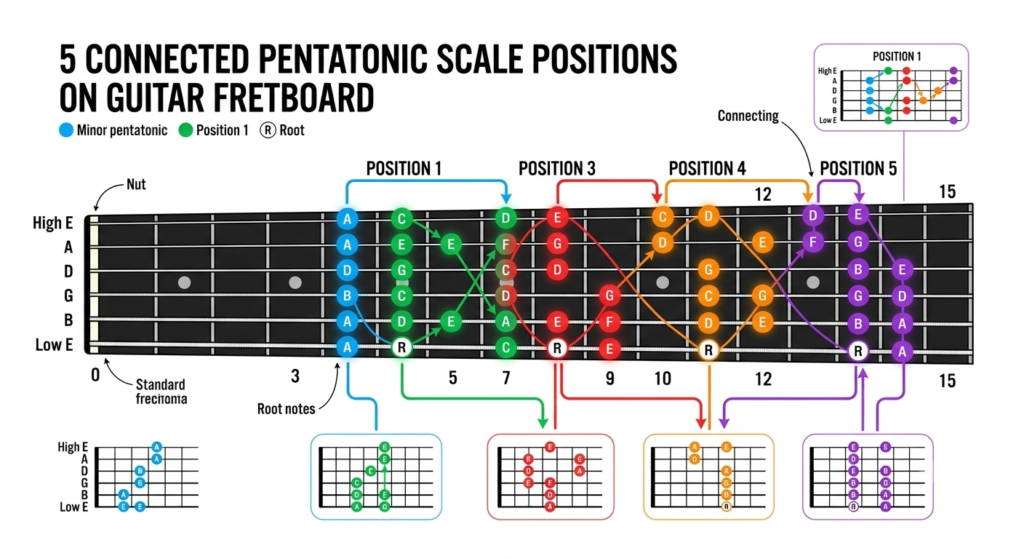
The four doorways are the five essential finger patterns that sit at the borders between pentatonic positions. Once your hands know these patterns, navigating between positions becomes intuitive — not memorized.
Here is what changes when you learn the doorways:
You Stop Thinking in Boxes
Instead of thinking “I am in Position 2 now, I need to remember what notes are in Position 2,” you simply move through natural connections your hands already understand. The positions become automatic.
You Can Solo in Any Key Immediately
When someone calls a key at a jam session, you no longer freeze. You know that the same doorways work everywhere on the neck — the relationships between positions are identical regardless of key. Consequently, transposing becomes effortless.
Your Solos Tell Stories
The most common complaint guitarists have about their own playing is that their solos go nowhere — they are technically correct but musically empty. When you can move freely between positions, you gain the full range of the instrument. Moreover, you gain dynamic control — the ability to build, release, and resolve tension across the entire neck.
You Play With Confidence
The box prison creates a specific kind of anxiety — the feeling that you are one key change away from being exposed. When you understand the unified system, that anxiety disappears. You know that wherever you are on the neck, you understand what is happening.
What You Get Inside The Best Minor Pentatonic Course
Adam Levine’s course — The Best Minor Pentatonic Course — is a structured digital program built entirely around the Nucleus Patterns Method. Here is what is inside:
🎸 The Nucleus Patterns Method — Complete System
The full explanation of how the five positions connect through the four doorways — presented in the logical sequence that makes the system click immediately rather than building confusion over weeks.
🎵 The Single Key Insight
The realization that from any single position, you can access five different keys without moving your hand. This is the foundational concept that restructures how you understand the entire fretboard.
✋ The 5 Essential Finger Patterns
The specific physical patterns that sit at the borders between positions — the doorways themselves. Once your hands know these patterns, they become the automatic connective tissue between everything you already know.
📝 Adam’s Specially Designed Etudes
Purpose-built exercises that train both hands to execute the connections automatically — without conscious thought. These are not random exercises. They are precision tools designed to install the doorway patterns into muscle memory as efficiently as possible.
🎯 Real-Time Application
Demonstrations of the entire system in real musical contexts — soloing over backing tracks, navigating key changes, building musical phrases that use the full neck.
Who This Course Is For — And Who Should Skip It
This Course Will Transform Your Playing If
- You have been playing guitar for at least one to two years and know at least one pentatonic position
- You feel stuck — your solos sound the same every time, in the same area of the neck
- You avoid jam sessions or freeze when someone calls an unfamiliar key
- You have memorized multiple positions and still cannot use them fluidly in real time
- You are in the US, UK, California, Canada, or Australia and want a structured, expert-led approach rather than scattered YouTube videos
- You want to understand the guitar rather than just memorize patterns
You Might Not Need This Course If
- You are a complete beginner who has not yet learned basic chords and single-note picking
- You are an advanced player who already navigates the full neck freely in multiple keys
- You are looking for a lick library or a collection of pre-learned solos rather than a systematic understanding of pentatonic structure
What Guitarists Are Saying After Taking the Course
Doug Smith, a 15-year guitarist and Facebook Community Member, said the approach Adam Loves Guitar uses sets this course apart from anything he had ever experienced with pentatonics. Adam Loves Guitar
The pattern across student feedback is consistent: players who have spent years trying to break out of the box prison — including experienced players who thought they already understood pentatonics — report that Adam’s doorway-based approach creates an immediate, tangible shift in how they experience the fretboard.
Furthermore, the most common feedback is not about a specific lick or technique learned. It is about a conceptual shift — the moment the entire fretboard suddenly makes sense as a unified system rather than a collection of disconnected shapes.
⚠️ Individual results vary. Guitar progress depends on consistent practice, prior skill level, and time invested in application.
Best Minor Pentatonic Course Pricing: Is It Worth the Investment?
The Best Minor Pentatonic Course is priced at $97 — a one-time payment for instant digital access.
To put that in context:
| Option | Cost | What You Get |
|---|---|---|
| Private Guitar Lessons (1 month) | $200-400 | General instruction |
| Generic Online Course | $50-200 | Shape-based approach that created the problem |
| YouTube (Free) | Free | The same backwards teaching — for years |
| The Best Minor Pentatonic Course | $97 | The specific system that solves the box prison |
🔒 7-Day Money-Back Guarantee
The course comes with a 7-day money-back guarantee. If you work through the material and it does not deliver the shift in understanding it promises, you can request a full refund within 7 days.
Building better guitar skills also requires focus, concentration, and consistent practice. If you’re exploring ways to support your mental performance while learning new skills, check out our The Brain Song Review to learn more about this popular brainwave audio program.
The Bottom Line
Millions of guitarists around the world — in the United States, United Kingdom, California, Australia, and beyond — are stuck in exactly the same place.
They know the pentatonic scale. They have practiced it for years. They still cannot solo freely.
The reason is not lack of practice. The reason is that they were never taught the four doorways between the positions — the connecting patterns that turn five separate shapes into one unified, flowing system.
Adam Levine has spent 50 years identifying and solving this specific problem. The Best Minor Pentatonic Course is the result of that half-century of teaching — distilled into the precise, logical, doorway-based method that has already helped thousands of guitarists across the US, UK, and worldwide finally break out of the box.
At $97 with a 7-day guarantee, the financial risk is minimal. The upside is finally playing the music you hear in your head — freely, confidently, anywhere on the neck.
If you are ready to stop memorizing shapes and start understanding the system, this is the course.
Frequently Asked Questions
No. You need to know at least one position — ideally Position 1. The course teaches you how all five connect, so prior memorization of all five is not required.
It is best suited for intermediate guitarists — players who can already pick single notes and navigate basic fretboard diagrams. Complete beginners should build basic technique before enrolling.
Most YouTube content teaches the same shape-based approach that creates the box prison in the first place. The Nucleus Patterns Method specifically addresses the connections between positions — the piece that conventional teaching has missed for 50 years.
Most students report a meaningful conceptual shift during or immediately after the core doorway lessons. Physical fluency across the neck develops over weeks of consistent practice with the Etudes.
This course is particularly valuable for exactly that situation. Knowing all five positions without the doorways is the most common description of the box prison. The course specifically addresses why memorization alone does not produce freedom.
Yes — a 7-day money-back guarantee is included with purchase.
This article is based on independent research and publicly available course information. We are not affiliated with Adam Loves Guitar. Always confirm current pricing and guarantee terms on the official website.
Also Read on LinkedIn
I’ve shared a concise version of this guide on LinkedIn, highlighting why so many guitarists struggle to move beyond the pentatonic box and what can help. Feel free to read it and join the conversation.
LinkedIn Article:
https://www.linkedin.com/pulse/youve-been-playing-guitar-years-so-why-you-still-stuck-sanju-ray-dlpsf
Explore More Reviews
- The Genius Switch (2026): A Science-Based Look at This Audio Brain-Training Program
 The Genius Switch (2026) Most of us know the feeling: … Read more
 - 4 Foot Farm Review (2026): Can You Really Grow Vegetables in Just Four Feet of Space?4 Foot Farm Review;Do you want fresh, homegrown vegetables but … Read more
- Money Surge Reviews 2026: Is Money Surge Legit or a Scam?⭐⭐⭐⭐⭐ 5/5 – (1 vote) Money Surge Reviews 2026;In this … Read more
- Why Is It So Hard to Find a Good Job Right Now?Hard to Find a Good Job;Finding a good job can … Read more
- Government Doesn’t Want You To Know This Water Trick ExistsSmart Water Box:Every month, millions of families across the United … Read more





2 thoughts on “You’ve Been Stuck in That Pentatonic Box for Years — Here Is Why, and How to Finally Break Free”