
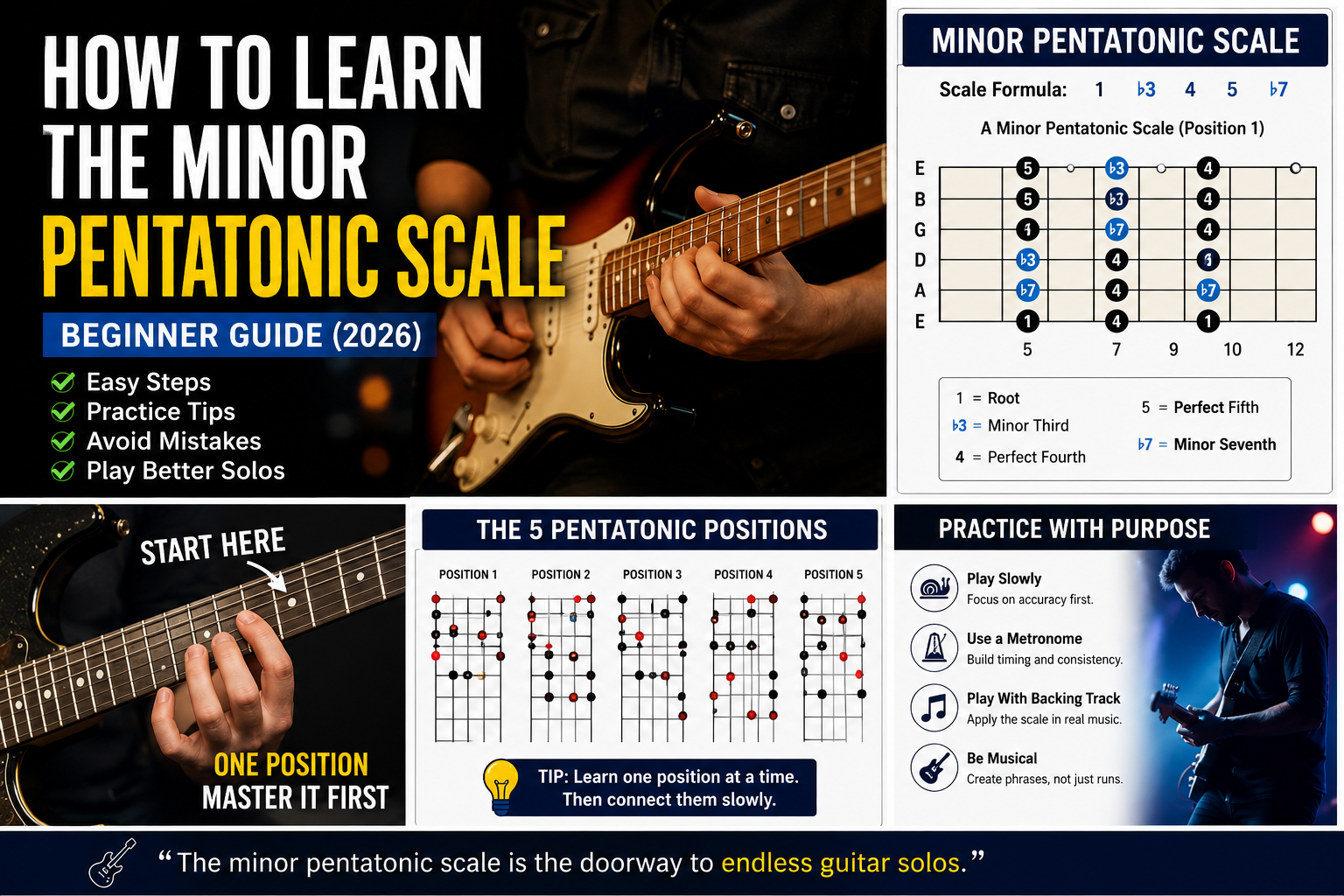
How to Learn the Minor Pentatonic Scale is one of the most common questions beginner guitarists ask when learning lead guitar. Whether you want to play blues, rock, or improvisational solos, understanding the minor pentatonic scale is the foundation of confident guitar playing. In this complete beginner’s guide, you’ll discover simple practice techniques, common mistakes to avoid, and the fastest way to improve your guitar solos.
Yet thousands of beginners eventually face the same frustrating problem.
They memorize a few scale boxes.
They can move their fingers quickly.
But when it’s time to improvise…
Everything suddenly falls apart.
The solos sound repetitive.
Every phrase feels identical.
And instead of playing music, they’re simply running up and down scale patterns.
If this sounds familiar, you’re definitely not alone.
Many guitar players in the United States, United Kingdom, Canada, Australia, and around the world spend years practicing without ever feeling comfortable moving freely across the fretboard.
The good news?
It isn’t because you lack talent.
It isn’t because your fingers are too slow.
Most players simply learn the scale in the wrong order.
In this complete beginner’s guide, you’ll learn exactly how to learn the minor pentatonic scale correctly, avoid the mistakes that keep most players stuck, and build a practice routine that actually leads to confident guitar soloing.
Why Every Guitarist Should Learn the Minor Pentatonic Scale
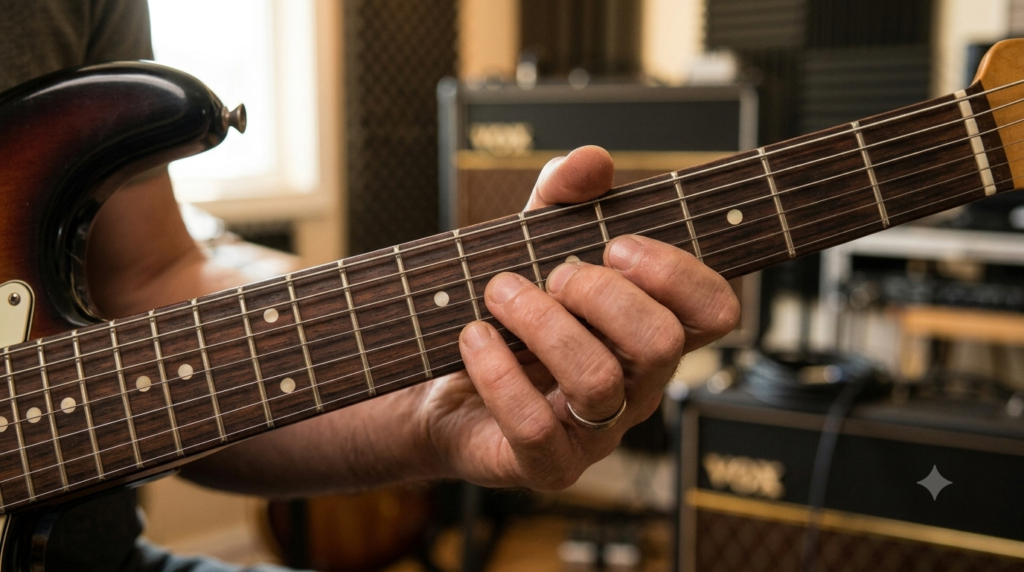
If you’ve ever listened to legendary guitarists like Eric Clapton, B.B. King, Slash, Jimmy Page, John Mayer, or Stevie Ray Vaughan, you’ve already heard the power of the minor pentatonic scale.
Despite being built from only five notes, this scale forms the foundation of countless famous solos across multiple genres, including:
- Blues
- Classic Rock
- Hard Rock
- Metal
- Country
- Pop
- Modern Worship Music
Unlike more complex scales, the minor pentatonic scale is relatively easy to memorize while still offering endless creative possibilities.
That’s exactly why almost every professional guitar teacher recommends learning it first.
However…
Simply memorizing the notes isn’t enough.
Understanding how they connect across the neck is what separates beginners from confident solo players.
If you already know the basics and want to connect every pentatonic position across the fretboard, read our complete Best Minor Pentatonic Course guide. It explains a structured learning system, course features, pricing, and whether it’s worth buying.
Read here:
https://productreviewarena.com/best-minor-pentatonic-course/
The Biggest Mistake Most Guitar Players Make
Here’s where most guitarists unknowingly get stuck.
They memorize Position 1.
Then Position 2.
Eventually Position 3…
Until they know all five boxes.
Unfortunately…
Knowing five separate boxes doesn’t automatically mean you understand the fretboard.
Many players spend years jumping between isolated shapes without understanding how every position connects together.
As a result:
❌ Solos sound repetitive.
❌ Improvisation feels confusing.
❌ Moving outside one position becomes uncomfortable.
This is why many experienced players still feel like beginners whenever they try to create original solos.
Fortunately, there’s a much smarter way to approach learning.
Improving focus and concentration can make daily guitar practice more productive. You can also read our detailed The Brain Song Review to learn about a brainwave audio program designed to support learning and mental performance.
Read here:
https://productreviewarena.com/the-brain-song-review/
How to Learn the Minor Pentatonic Scale: Start With One Position First
When you’re first learning the minor pentatonic scale, don’t rush into memorizing all five positions immediately.
Instead:
Learn one position extremely well.
Practice it until you can:
- Play it without looking.
- Recognize every root note.
- Create small musical phrases.
- Bend accurately.
- Add vibrato naturally.
- Play with backing tracks.
Your goal isn’t speed.
Your goal is musical confidence.
Once Position 1 becomes second nature, connecting the remaining positions becomes dramatically easier.
How to Learn the Minor Pentatonic Scale: A Simple 7-Step Practice Routine

If you’ve been wondering how to learn the minor pentatonic scale without feeling overwhelmed, the secret isn’t practicing longer—it’s practicing smarter.
Here’s a simple routine that many experienced guitar players use to build confidence on the fretboard.
Step 1: Memorize One Shape Completely
Most beginners make the mistake of trying to learn every pentatonic position within a few days.
Don’t do that.
Instead, spend several practice sessions mastering Position 1.
Know where every root note sits.
Play it forward and backward.
Practice slowly before increasing your speed.
Remember:
Slow practice creates clean muscle memory.
Fast practice creates mistakes.
Step 2: Practice With a Backing Track Every Day
Playing scales without music quickly becomes boring.
Instead, use a simple blues or rock backing track in the same key.
For example:
• A Minor Blues Backing Track
• E Minor Rock Backing Track
Even if you only know five notes, start making music immediately.
This develops your ear much faster than memorizing patterns alone.
Step 3: Learn Small Musical Phrases Instead of Long Runs
One reason many guitar solos sound robotic is because players simply run the scale from beginning to end.
Professional guitarists rarely do that.
Instead, they create short musical ideas.
Practice:
• Two-note phrases
• Three-note phrases
• Bend one note
• Pause
• Answer with another phrase
Think of your solo as a conversation—not a race.
Why Most Guitarists Get Stuck While Learning the Minor Pentatonic Scale
This may surprise you.
Many players spend five or even ten years practicing guitar but still struggle to improvise confidently.
Why?
Because they focus on memorizing shapes instead of understanding connections.
The fretboard isn’t made of five separate boxes.
It’s one connected musical map.
Once you understand how every position links together, moving around the neck starts feeling natural instead of confusing.
Step 4: Connect Two Positions Before Learning All Five
Instead of trying to memorize every shape at once, connect Position 1 with Position 2.
Then Position 2 with Position 3.
Then continue gradually.
This creates smooth movement across the neck without overwhelming your brain.
Many experienced teachers recommend this progressive approach because it’s easier to retain over the long term.
Step 5: Train Your Ear Along With Your Fingers
One of the biggest differences between average and advanced guitar players is ear training.
Don’t just memorize finger movements.
Listen carefully to every note.
Ask yourself:
• Does this note sound resolved?
• Does this note create tension?
• Which note feels like “home”?
Over time, your ears will begin guiding your fingers naturally.
That’s when improvisation becomes enjoyable.
Step 6: Practice Every Day (Even for Just 20 Minutes)
Consistency always beats marathon practice sessions.
A simple daily routine might look like this:
• 5 minutes — Warm-up exercises
• 5 minutes — Minor Pentatonic Position 1
• 5 minutes — Improvising with a backing track
• 5 minutes — Learning new licks
Twenty focused minutes every day is often far more effective than practicing for three hours once a week.
Step 7: Learn How All Five Positions Connect
Eventually, every guitarist reaches a point where memorizing individual boxes is no longer enough.
The next step is understanding how every pentatonic position flows naturally into the next.
This is where many players finally experience the “lightbulb moment.”
Instead of seeing disconnected patterns, they begin seeing one complete fretboard.
If you’re ready to move beyond isolated scale shapes and learn a structured system for connecting all five positions, our detailed guide on the Best Minor Pentatonic Course explains one approach designed specifically for that goal.
👉 Read the complete guide here:
The article explores the course structure, learning method, pricing, and who may benefit most from it before making a purchasing decision.
Common Mistakes Beginners Should Avoid
Even talented guitar players often slow their progress by making a few common mistakes.
Trying to Learn Everything at Once
Learning five positions in a weekend usually leads to frustration.
Master one before moving to the next.
Practicing Too Fast
Speed comes naturally after accuracy.
Always practice slowly enough to play cleanly.
Ignoring Timing
A scale played with great rhythm always sounds better than a fast scale played without control.
Use a metronome whenever possible.
Never Playing With Music
Improvisation only develops when you practice over real music.
Backing tracks help bridge the gap between exercises and actual performance.
Skipping Ear Training
Your ears should tell your fingers where to go—not the other way around.
Learning intervals and recognizing note sounds will dramatically improve your improvisation skills.
How to Learn the Minor Pentatonic Scale: Frequently Asked Questions
Yes.
The minor pentatonic scale is one of the easiest guitar scales for beginners because it uses only five notes and works in many musical styles including blues, rock, country, and pop.
Most beginners can memorize the first position within a few days.
Learning all five positions and using them confidently in solos usually takes several weeks or months, depending on how consistently you practice.
Yes.
Learning one position is a great start, but connecting all five positions gives you complete freedom to move across the fretboard while improvising.
Absolutely.
Many legendary guitar solos are built almost entirely around the minor pentatonic scale.
The key is learning phrasing, bends, rhythm, and note choice rather than simply running the scale.
For most beginners, 20–30 minutes of focused daily practice is more effective than several hours of inconsistent practice once a week.
The most common mistake is memorizing scale shapes without learning how they connect. This often leaves players stuck in one position and unable to improvise naturally.
A structured online course can be valuable if it provides a clear learning path and practical exercises. Compare the course content, teaching style, and refund policy before deciding if it matches your goals.
Related Articles
You may also enjoy these guides:
🎸 Best Minor Pentatonic Course
🧠 The Brain Song
1 thought on “How to Learn the Minor Pentatonic Scale: The Beginner’s Roadmap to Better Guitar Solos”